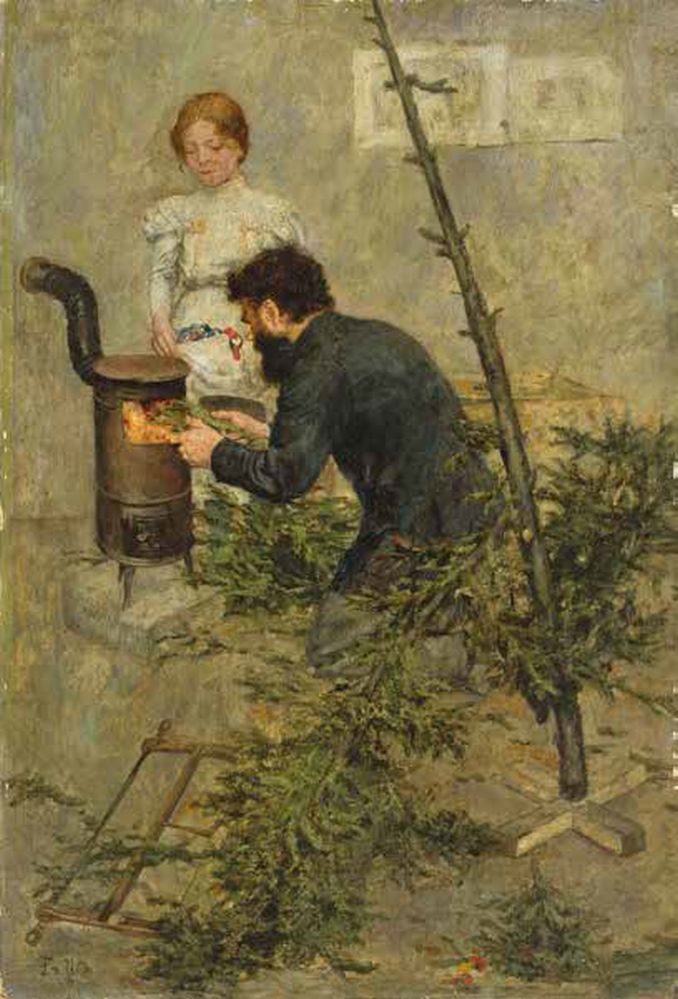
After Christmas (Nach Weihnachten)
Fritz von Uhde (1848-1911). Oil on cardboard. Public-domain artwork. Wikimedia Commons, via Villa Grisebach, Berlin. Photograph credited to Karen Bartsch.
A Christmas Ghost Story
The parcel arrived on Christmas Eve, just as the light was failing.
It had been left outside the workshop door, wrapped in brown paper and tied with a length of ordinary kitchen string. There was no address, no stamp, and no name. Only a small label, its edges yellowed, bearing three words in a fine, sloping hand.
For the binder.
Thomas Vale stood looking at it for some time.
At eighty-three, he had learned that most mysteries were disappointments waiting to be explained. A parcel without a sender usually contained something broken, something unwanted, or something for which payment would never be forthcoming. Nevertheless, he took it inside.
The workshop occupied the ground floor of a narrow house at the end of Bell Lane. Its windows were uneven. Its chimney leaned slightly towards the church. And its front door had swollen so thoroughly with age that it refused to close in damp weather without a good shove.
Inside, everything had its place.
The sewing frame stood beneath the window. The finishing tools hung above the bench. Rolls of bookcloth occupied the upper shelves, while the good leather, wrapped in linen, rested in a cabinet away from the stove.
Thomas had kept the workshop much as his father had left it.
There were newer machines, certainly, and a small electric heater beneath the bench, but he preferred the old ways. A book properly sewn would outlive its owner. A good binding should not draw attention to itself. And paper, he knew, had a memory.
He placed the parcel beside his cutting press.
Outside, the church clock struck four. Thomas lit the candle in its glass lantern beside the window, as Eleanor had always done on Christmas Eve for anyone travelling in the dark. Then he untied the string. Inside was a book.
It was small, no larger than a man's hand. Its dark blue cloth had faded almost to grey. The spine had separated from the boards. The headbands hung loose. Someone had attempted a repair with glue many years earlier, leaving a hard yellow ridge along the hinges.
The title, The Songs the Wind Can Play, was impressed in worn gold. Its lettering was barely legible.
Thomas touched the lettering. He knew the book. Or rather, he had known another like it.
Forty years earlier, his wife Eleanor had brought him a manuscript of poems gathered from friends, neighbours and people who had passed through the town. She wanted a little Christmas book. Something to give away rather than sell. He had made twenty-five copies.
Eleanor had stitched the decorative endpapers herself. She had painted tiny stars along their edges in blue and silver. Thomas had bound each volume by hand. They had given away twenty-four.
The last copy had remained on their mantelpiece until the winter Eleanor died.
After the funeral, Thomas had put it somewhere safe. He had never found it again.
He opened the book.
The title page was familiar, as was Eleanor's little drawing of a linnet perched on a snow-covered branch. But the pages were uncut.
Thomas frowned. He remembered trimming every copy himself. He remembered Eleanor standing beside the guillotine. She had objected to the waste of good paper, then laughed when he told her there was no other way to make the leaves even. Yet here were folded gatherings, their top edges still joined.
He turned the book gently, examining the sewing. There was none of the usual damage that came from being pulled apart and rebound. The book appeared to have been made this way from the beginning.
He fetched his paper knife. The first joined leaves opened with a soft tearing sound.
A poem appeared.
He recognised it immediately. Eleanor had written it during their first winter together. It was about a blackbird that came to their kitchen window each morning, demanding crumbs with the imperious confidence of a landlord collecting rent. Thomas smiled. He had forgotten the blackbird.
He cut the next gathering.
There was a sketch of their first house, the little cottage beyond the mill, with its crooked apple tree and the stone path he had laid himself. That was strange. There had been no drawings of houses in Eleanor's Christmas collection.
He looked more closely. Beneath the sketch, in the same neat hand, were the words: Christmas, 1962. A memory came back so suddenly that he sat down.
That Christmas, the pipes had frozen. Eleanor had cooked their dinner on a paraffin stove, and the pudding had fallen into the washing-up bowl. They had eaten bread, cheese and oranges instead, sitting beneath a blanket while the windows filled with frost.
He remembered her laughing. Not the incident itself, but the sound of her laughter.
He had not heard it in his mind for years.
The workshop grew colder. Thomas put another piece of coal on the stove and returned to the book.
The next pages contained a Christmas party at his mother's house. His brother David was there, holding a paper crown above his head. His mother stood at the kitchen table, cutting slices of fruitcake. Eleanor sat near the fire, one hand resting on the shoulder of their little daughter, Ruth. The picture was so exact that Thomas could see the chipped blue plate on the table.
David had died in 1981.
His mother had been gone nearly fifty years.
And Ruth—he stopped.
Ruth was alive, of course. She lived two hundred miles away and had a family of her own. They spoke on the telephone every Sunday. She had invited him for Christmas, as she did every year, and he had declined.
The journey was too long.
The weather was uncertain.
The workshop needed watching.
He had become very accomplished at finding reasons.
Thomas looked down. Under the drawing, in Eleanor's handwriting, was a single sentence.
You were happy then.
He closed the book. The church clock struck five.
For several minutes he sat beside the stove, listening to the wind pressing against the windowpanes. Then he opened the book again.
He cut through another gathering of pages. An illustration showed the workshop, but not as it was now.
The bench was newly scrubbed. The walls were white, and the window held a row of little plants in clay pots. Eleanor stood near the sewing frame, carrying a tray with two mugs.
It was Christmas Eve, 1986. He knew the year because the following February Eleanor had fallen ill.
Thomas stared at the drawing. He had forgotten that afternoon.
Ruth had come home from university unexpectedly. She had arrived in a borrowed car, carrying a ridiculous knitted scarf for her mother and a packet of expensive Japanese paper for him. They had sat together until late, talking about nothing important.
It was the last Christmas Eleanor spent in the workshop. He examined the drawing again. There was now a third mug on the tray. Thomas reached for his spectacles, removed them, and wiped his eyes.
When he looked again, the drawing had changed. Eleanor was no longer carrying the tray.
She was standing by the window, looking out.
On the page opposite, words appeared in a hand he knew better than his own.
How lovely of her to come home.
Thomas leaned forward.
The lettering grew pale, as though the paper were drawing the ink back into itself.
Then he heard a small sound behind him. The workshop door had opened. Or perhaps the wind had pushed it against the frame.
He did not turn immediately. For a moment, hope frightened him more than fear.
“Eleanor?”
No answer came.
Only the soft ticking of the clock above the stove. He turned.
The room was empty.
But a third mug stood on the bench. It was blue, with a broken handle carefully repaired.
Eleanor’s mug. The paper had remembered it; now the room seemed to remember too.
Thomas rose so quickly that his chair struck the floor. In the candlelight, his shadow moved across the bench as he approached the cup. He touched it. It was warm. Inside was tea, and a little steam lifted from its surface. He looked towards the door, then the window, then back at the book. “Eleanor,” he said again, very softly.
The workshop seemed to settle around him. A coal shifted in the stove.
Somewhere upstairs, a floorboard creaked. He knew every sound the house could make. He had heard them through forty Christmases, through storms and summers, through years of company and years of solitude.
This sound was different. It was the sound of someone crossing the bedroom floor.
Thomas sat down.
There were only two gatherings left uncut. He opened the first.
The page was blank.
Then, slowly, a picture emerged. It showed a dining room with a long oak table. Paper stars hung from the ceiling, and a small Christmas tree stood beside the window.
Around the table sat Ruth, her husband, their children, and two little boys Thomas did not recognise. At the far end was an empty chair.
A place had been set for someone. Thomas studied the picture.
The children were older than he remembered. The youngest girl had become a young woman. One of the boys wore spectacles. Another had the same unruly hair Thomas himself had worn as a child. He looked at the date beneath the drawing: Christmas Day, 2026.
Tomorrow.
His hands began to tremble.
At the foot of the page was another sentence.
There is still a place.
Thomas leaned back. The clock struck six.
He looked towards the telephone.
Ruth would be preparing supper now. There would be children running through the kitchen, doors opening and closing, the television programmes making their customary contribution to the general confusion.
He imagined her answering his call. He imagined telling her he had changed his mind.
He almost laughed. The trains would be impossible on Christmas Eve. Even if he could find one, he would arrive late. He had no present ready, no overnight bag packed, and the weather had begun to turn.
Outside, snow was falling.
He looked at the empty chair in the drawing.
Then he picked up the telephone.
Ruth answered on the fourth ring.
“Dad! Happy Christmas Eve!”
“Happy Christmas, my dear.”
“Are you all right?”
“Yes. Quite all right.”
He glanced at the little book.
“I was wondering,” he said, “whether that invitation might still be open.”
There was a silence.
Then Ruth said, “Oh, Dad.”
He heard her take a breath.
“Of course it is.”
“I don't know if I can get there.”
“Don't worry about that. We'll come and fetch you.”
“Two hundred miles?”
“Dad, it's Christmas.”
Behind her, someone shouted. A door slammed. Ruth laughed and called for quiet.
Then she returned to the telephone.
“Just be ready in the morning.”
After the call, Thomas sat for a long time. The workshop seemed warmer. He put the mug beside the book and looked at the final gathering.
Its edges were still joined.
He knew he ought not to open it.
The thought came with complete certainty. There were things a man was not intended to know. The years behind him were heavy enough without borrowing from those ahead.
He set the paper knife down.
Then he noticed something.
The string from the parcel lay across the bench in a loose figure of eight.
At its centre was a small knot. Eleanor had always tied parcels that way.
She said a bow was unreliable. A proper knot, once made, should remain until someone chose to undo it. Thomas lifted the string.
A scrap of paper had been caught beneath the knot. He unfolded it.
The writing was faint, but perfectly legible.
Don't spend the last of the light looking backwards.
He sat very still.
Then he laughed.
It began as a small, astonished sound, and grew until he was laughing as he had not laughed in years. “Bossy woman,” he said.
He took the book to the mantelpiece and placed it beneath Eleanor's photograph.
The final gathering remained uncut.
By seven o'clock, Thomas had packed his bag. By eight, he had found the little silver bookmark he had bought for his granddaughter the previous Christmas and forgotten to send. By nine, the tools were put away, the stove was banked, and the workshop was ready to be closed.
He returned once more to the mantelpiece. The book was gone.
In its place lay a small folded sheet of blue paper, decorated with silver stars.
Thomas opened it. There was no writing.
Only a tiny drawing of a linnet on a snow-covered branch. He held it for a moment, then slipped it into his coat pocket.
Outside, the snow had stopped.
The moon stood above the church roof, and the wind moved through the narrow lane with a sound almost like distant singing.
Thomas turned off the workshop lights.
The candle still burned beside the window.
He reached to extinguish it. Then he changed his mind.
He left it burning in its little glass lantern and closed the door.
For once, he would not be spending Christmas alone. And somewhere, beyond the reach of clocks and calendars, a woman with paint on her fingers was finishing the last silver star.
The End
|